I. What is a three-pass boiler
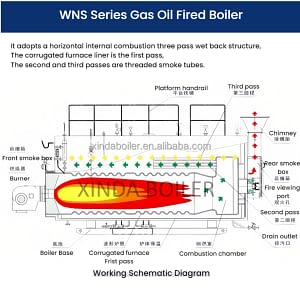
The three-pass mainly refers to the three round-trip processes in which the flue gas flows inside the boiler and scour the heated surface.
The vast majority are used in fire-tube/shell-type oil and gas-fired steam boilers.
The basic process of the second and third return structures
The first return trip
The flue gas flows directly backward from the combustion chamber (furnace liner)
It mainly relies on radiation heat exchange, with the highest temperature and the strongest heat exchange.
The second trip
The flue gas turns through the front flue box and enters the flue pipe to flow forward, mainly through convective heat transfer.
The third round trip
The flue gas turns again after passing through the rear smoke box and enters another set of smoke pipes to flow backward, further absorbing the residual heat, and is finally discharged through the chimney.
Iii. Core Characteristics of the Three-Pass Structure
It has a large heating area and high thermal efficiency
The flue gas travels through three stages to extend the heat exchange path. It fully absorbs heat, has a low flue gas temperature, and the thermal efficiency is usually ≥90%
2. Compact structure and small volume
Under the same evaporation capacity, it is smaller in volume and occupies less space than single-pass and double-pass boilers, making it suitable for occasions with limited machine room space
3. Sufficient heat exchange and good energy-saving effect
High-temperature flue gas repeatedly scour the heating surface, reducing heat waste and lowering fuel consumption
4. Stable operation and good load adaptability
The furnace has a large volume and ensures complete combustion. The steam pressure and water level fluctuations are small
5. The flue gas flow is reasonable and the resistance is moderate
The smoke pipes are neatly arranged and the airflow is smooth. The power consumption of the fan is reasonable and it is not easy to accumulate dust and get clogged
6. Good heat preservation and low heat loss
The pot shell is wrapped with a high-density insulation layer, which has a low surface temperature and small heat dissipation loss
Four. Disadvantages of three-pass boilers
There are a large number of smoke pipes, and it is rather difficult to clean them after they are scaled
The flue gas flow is long, and the requirements for the induced draft/forced draft system are slightly higher
The internal smoke box is prone to local wear and dust accumulation at the turning points
V. Scope of Application
Small and medium-sized oil and gas-fired steam boilers
The evaporation rate is generally 0.5t/h to 20t/h
It is widely used in factory production, hospitals, hotels, schools, and heating and heat supply
Vi. Summary
Three-pass boilers achieve large heating surfaces, high efficiency, compact structure, energy conservation and stability through three round trips of flue gas heat exchange. They are currently the mainstream structure for small and medium-sized gas/oil-fired steam boilers.