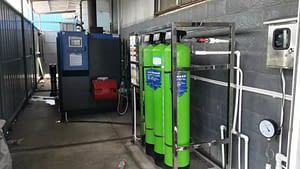
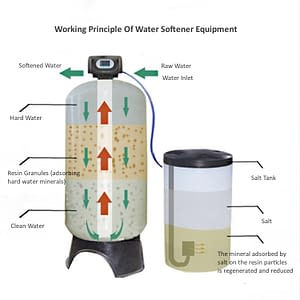
The core working principle of a water softener is that when hard water passes through the sodium ion exchange resin inside the device, the calcium and magnesium ions that form scale in the water will be exchanged with the sodium ions on the resin. The calcium and magnesium ions are adsorbed by the resin, thus turning the effluent water into soft water without scale. When the resin reaches adsorption saturation, the machine will automatically draw in saturated brine to regenerate and flush the resin. The high-concentration brine is used to replace the calcium and magnesium ions on the resin and discharge them with the wastewater, allowing the resin to re-adsorb sodium ions and restore its softening capacity. This cycle ensures continuous water supply.

Performance advantage
Thorough scale removal: It can reduce hardness to below 0.03mmol/L, with almost no scale.
Stable effluent: The resin and control program are mature, and the water quality fluctuates little.
High automation: The fully automatic model can automatically soften, regenerate and backwash, and only requires regular salt addition.
Long service life: The tank body is mostly made of fiberglass reinforced plastic/stainless steel, which is corrosion-resistant. The resin can be used for 3 to 5 years.
Protect equipment: Water heaters, washing machines and dishwashers from scaling, extend their lifespan and reduce energy consumption.
Protect pipelines: Reduce scaling and clogging, and lower maintenance costs.
Low energy consumption: Only part of the electricity is controlled, with almost no additional energy consumption.
Small footprint: The tank is compact and can be installed in a cabinet/equipment room.